
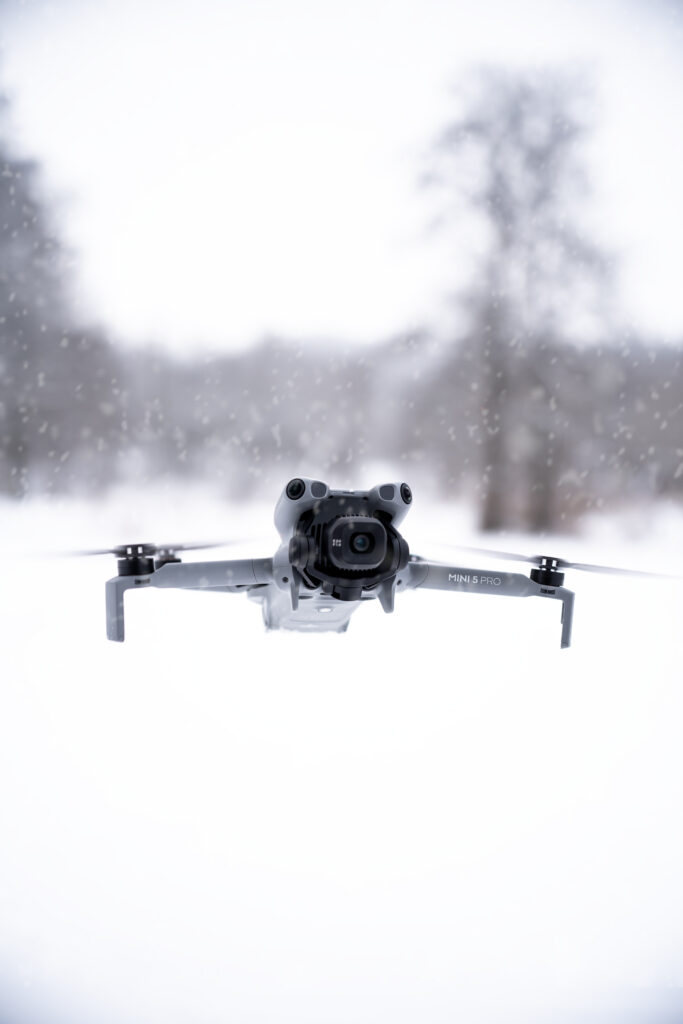
Winter does not mean a pause in drone flying. On the contrary – cold, clear air, snowy landscapes, and less crowded airspace offer unique opportunities for both DJI camera drones and FPV flights. At the same time, winter brings its own technical and physical challenges, and ignoring them can result in damaged equipment or even dangerous situations.
The most important factor in winter flying is the battery.
Cold temperatures affect both DJI intelligent batteries and FPV LiPo and Li-ion batteries. Low temperatures reduce a battery’s ability to deliver power, shortening flight time and potentially causing sudden voltage drops. This is especially noticeable in FPV flying, where high current draw combined with a cold battery can lead to unexpected power loss. For this reason, batteries should be kept warm before flight – for example in a pocket, bag, or insulated case – and installed only just before takeoff. At the beginning of the flight, flying gently rather than aggressively also helps the battery warm up.
Cold weather also affects the pilot.
In FPV flying, hand precision is critical, and stiff, cold fingers significantly reduce control. Warm gloves, hand warmers, or even flying from a sheltered, wind-free spot can greatly improve comfort. Some pilots also fly from inside a car in winter – this is possible, but it requires awareness, as it may reduce signal strength. In addition, maintaining the required visual line of sight for the open category can be more difficult from inside a vehicle.
Winter weather and environments can be deceptive.
Snow and fog reduce visibility, and moisture is dangerous for electronics. With DJI drones, it is especially important to monitor sensors and GPS signal. With FPV drones, cold temperatures make plastic parts and propellers more brittle – crashes that would result in minor scratches in summer can cause broken components in winter. It is therefore wise to carry extra spare propellers and avoid landing directly in snow. In winter, a landing pad is not a luxury but a practical necessity.
For FPV flying, winter also brings the issue of goggles fogging up.
Temperature differences cause condensation, which can make the image unusable in seconds. Pre-heating the goggles, turning them on before flight, and avoiding sudden temperature changes help reduce this risk.
Camera settings also require extra attention in winter.
Snowy landscapes often fool automatic exposure systems – both DJI drones and FPV cameras tend to produce images that are too dark or greyish. For best results, shoot in RAW format, which allows white balance to be corrected in post-processing, and use ND filters on the drone. These filters act like sunglasses for the camera lens, reducing excessive light when shooting in bright conditions with a low winter sun.
After the flight, maintenance is just as important.
In winter, condensation forms most easily when a cold drone is brought quickly into a warm environment. A good practice is to leave the drone and batteries in the bag at first and allow them to warm up slowly. For FPV drones, moisture protection such as conformal coating helps protect the electronics, but even then, everything should be carefully dried after flying.
In summary
Winter drone flying is not difficult if you understand the effects of cold on batteries, electronics, and yourself. Proper preparation, a calm flying style, and careful post-flight care make it possible to fly safely in winter and enjoy views and experiences that are simply not available in summer.
Winter is not a pause in drone flying – it is simply a different season.